Log in


Click here to go see the bonus panel!
Hovertext:
They actually say modulus, but journalists dumb it down.
Today's News:
Hovertext:
They actually say modulus, but journalists dumb it down.




Hovertext:
In the final round, they pelt you with eggcorns.

Hovertext:
Disobey God and get drowned immediately is really more of an Abrahamic religion thing.

Pity the poor Australians. Isolated on a jagged hunk of land far from everywhere else, these industrious people have to take two-legged flights (or more) to reach a great many destinations in the northern hemisphere. It’s expensive, time consuming, and makes planning a trip a complete headache when wars break out around popular hub airports.
One airline is trying to solve this problem. The nation’s flag carrier, Qantas, has been hard at work on Project Sunrise. The goal is to run some of the longest non-stop commercial passenger flights ever, with great effort going into solving the technical and economic challenges involved.
When travelling from Australia’s major capital cities, flights to destinations like London, the rest of Europe, or the US, all involve stopovers in intermediate airports along the way. A great many routes stop in Dubai or Qatar, while others transit through Hong Kong, Singapore, or Thailand. The need for stopovers complicates air travel for the passenger, particularly when delays cause missed connections or baggage gets lost from one flight to another. It can also just be tedious—sometimes a stopover can last 10 hours or more, which is an incredibly uncomfortable amount of time to spend in even the nicest airport. The reason behind stopovers is simple enough—the average commercial airliner just doesn’t have the fuel range to haul many hundreds of passengers from Australia to Europe in a single hop.

Qantas has been trying to improve Australia’s passenger airline links for quite some time by finding ways to eliminate these tedious stopovers entirely. Thus was born Project Sunrise, which hoped to find more direct routes between popular world cities and suitable airliners that could fly those routes without stopping.
An early 2019 test flight probed the practicality of flying from New York to Sydney in a single hop. Due to the limitations of contemporary aircraft, sacrifices were made to get the flight over the line. Where the Boeing 787-9 would normally carry up to 280 passengers, the test flight would only haul 40 to save weight, and thus save fuel. No cargo was on board, and the tanks were brimmed to ensure maximum range was available. Even then, the 16,250 km route was considered to be at 115% of the plane’s normal range, and there was only 90 minutes of contingency when it came to fuel onboard if something went awry. Despite the challenges, the test was a success, and provided useful learnings on how to handle things like crew fatigue on a 19-hour continuous flight.
Qantas was also experimenting with practical revenue services at this time, too. In 2018, the airline had established a direct route from Perth to London, flying the Boeing 787-9 in a 236-seat configuration. Flying the 14,484-kilometer route was just within the practical range of the aircraft. It was a useful route that made travel easier for passengers departing Australia’s west coast, but far from the golden ideal of allowing direct flights to major international destinations from the major capitals of Melbourne and Sydney. The route has also since fell victim to geopolitical strife, as the Iran War shut down large swathes of airspace in early 2026. Qantas was forced to alter its flight paths, which added 30 to 45 minutes to the usual flight time—just enough to tip the route over the practical limitations of the aircraft’s range.
However, the crowing achievement of Project Sunrise is still yet to come. 39% of Australia’s population is concentrated in Sydney and Melbourne alone, with both capitals situated on the country’s east coast. It would be most advantageous from a business perspective for these cities to have direct links to major world destinations, and it would benefit the broadest swathe of Qantas’s customer base. Only, the problem comes back to geography, with these two capitals being over 16,000 kilometers from popular destinations like New York and London.
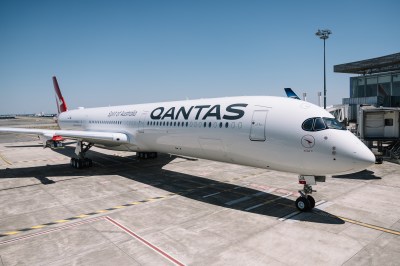
Qantas has risen to the challenge, regardless. The airline challenged both Boeing and Airbus to develop aircraft intended to fly routes from Sydney, Melbourne, and Brisbane, to destinations like New York, London, Cape Town, Paris, and Rio de Janeiro. This was later whittled down to a narrower focus on the Sydney to New York and Sydney to London routes. Airbus would come out victorious, with Qantas ordering twelve examples of the Airbus A350-1000ULR. The specially-configured model features an additional rear centre fuel tank and a higher maximum take-off weight in order to fly routes up to 22 hours non-stop, along with a reduced seat configuration serving just 238 passengers. The extra range makes for a huge difference compared to more conventional routes out of Australia, which often pair two flights up to 14 hours each. The extra range of the new aircraft saves passengers both hours of flight time, along with the hours normally spent sitting around on layover in a hub airport along the way.
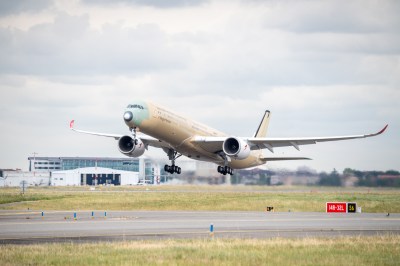
A typical flight from Sydney to New York or Sydney to London is expected to take 19 to 22 hours. The no-stop nature of the route will enable 99% of Australians to access either destination either direct, or with one-stop—such as by flying in from another major capital on a domestic flight. The flights are expected to run with a higher-than-usual ratio of premium seats, based on the expected demand for these services.
The main thing holding back the new service is aircraft delivery. Production is underway in earnest, with the first A350-1000ULR to be delivered in April 2027. Daily non-stop flights between Sydney and London will begin from October 2027, with tickets to be on sale from February.
Aircraft cabins will be optimized to have more space and amenity to keep passengers comfortable on ultra-long-range routes.
The new Project Sunrise services will be a gamechanger for many people travelling to and from Sydney, and other Australian capitals. It will relieve a major pain point—layovers—that have become a dreaded fact of life for Australians headed far abroad. It will still perhaps be some time before Australians get more direct services to a wider range of destinations, because these new services will have to prove themselves. If the passenger numbers aren’t there, the services won’t make money, and it may not prove worth the hassle to operate these ultra-long-range routes. If, however, convenience truly is king, then there may be much greater investment in this area to link Sydney and Melbourne with more cities directly. The only losers in this case will be the hub airports across the world, which will grow just a little quieter for the loss of Aussie accents in the terminal.

NASA’s James Webb Space Telescope is back with another stunner: a new 223-megapixel composite featuring about 16.5 million stars that have been evolving over several million years. Captured by Webb’s NIRCam (Near-Infrared Camera) across 65 hours, the enormous image features Messier 82, also known as the Cigar galaxy, which is located 12 million light-years away.
“M82 is a mess, but it’s a beautiful mess,” said NASA fellow Adam Smercina. “We don’t fully understand what’s going on, especially concerning its evolutionary history. What could have triggered such an elevated rate of star formation? How long has this galaxy been driving plumes of material away from its center?”

Initial speculation includes a galaxy merger causing rapid star formation 10 times faster than that of the Milky Way and lasting a few hundred million years, which researchers describe as “a short-lived event in astronomical terms.” Although we can see many of these stellar objects as blue granules, there are likely many more invisible to us.
Hubble had previously looked at the galaxy, but the technology was unable to capture the same detail as Webb. As shown in a side-by-side comparison, Hubble captures many of the dust grains and ionized hydrogen gas depicted in red, orange, and yellow, while Webb highlights the staggering density of stars.
“Galaxies are such intricate ecosystems that if you truly want to understand them, you have to pull datasets from different missions together,” said Kristen McQuinn, of the Space Telescope Science Institute. “One mission cannot fully answer all of the questions we have about M82. Combining the data collected by different telescopes, like Webb and Hubble, is powerful. When you marry the datasets, you expand what you can probe, and the questions that you can pose are even more complex.”

Do stories and artists like this matter to you? Become a Colossal Member today and support independent arts publishing for as little as $7 per month. The article In a New 223-Megapixel Image, NASA Captures 16.5 Million Stars of the Cigar Galaxy appeared first on Colossal.

The train was one of the game-changing inventions that defined the Industrial Age. No more would humanity rely on tempestuous animals to haul goods and passengers great distances across the land. Fire and steam came along to rapidly increase the speed of travel and transformed the very fabric of society itself.
To this day, the vast majority of train networks rely on the same basic principle—heavy locomotives and carriages running steel wheels on steel tracks. Yet, there is a curious alternative twist on this concept that sees trains of carriages riding on tires instead. But what would possess anyone to build a rubber tired train?
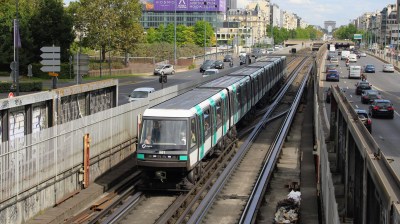
The first practical rubber-tired train system came about in the wake of World War II. The Paris metro had been poorly maintained during the German occupation, and was in dire need of repair or replacement. The state-owned public transport operator RATP and tire supplier Michelin came to the table, developing a concept wherein vehicles running on pneumatic tires would ride on a flat steel or concrete “rollway.” The vehicles would also have backup steel wheels that run against a steel rail for safety, keeping the train upright in the case of a tire blowout. Guidance would be provided by extra rubber tires mounted to the wheel bogies on a vertical axis, running against a vertical guideway built into the track, in a manner not dissimilar from later O-Bahn systems.
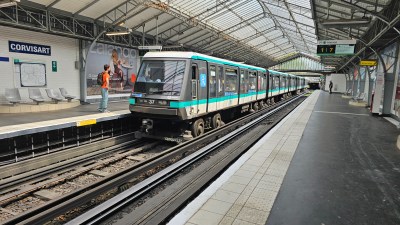
By the 1950s, when the concept was being seriously developed, steel-wheeled railways had been around for well over a century. They were the norm for good reason, but running rubber-tired trains did offer some advantages. The pliable tires would soak up vibrations, which was both good for passenger comfort as well as also virtually eliminating high-pitched squealing noises that are common on steel railways.
The rubber tires, running on concrete or steel surfaces, also offered greatly improved grip. This allowed the rubber-tired metro trains in Paris to climb much greater grades with ease, compared to traditional steel-wheeled railcars. It also aided in early automation efforts on the Paris Metro, as the higher grip level made it easier to ensure locomotives stopped at the right position when entering stations. Rail wear is also greatly reduced compared to steel-on-steel systems.
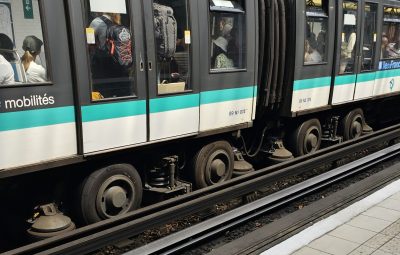
Of course, rubber tires also came with some drawbacks. Tracks were more expensive to build due to the need to incorporate both rollways and guideways, and commonly a steel rail to supply electricity to the trains. Rubber tires don’t last as long as steel wheels, either, aren’t as robust, and are subject to blowouts when damaged. The flexing of pneumatic rubber tires also makes the trains less energy efficient, and generates more heat in operation, which can be a concern in underground operations. As tires break down, they also create particulate pollution which isn’t great for urban air quality or for the people breathing it in.
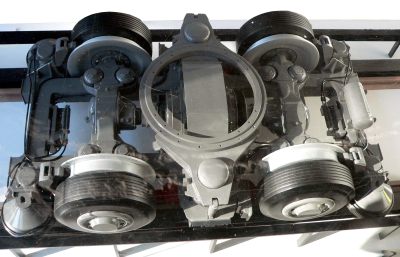
The Paris Metro found the oddball concept to be of great use, particularly given some of the higher grades faced in certain parts of the network. In time, lines 1, 4, 6, 11, and 14 would all be retooled to the Michelin-designed system with rubber-tired railcars running on 1,435 mm rollways. Various airport routes would later adopt rubber tired services, too, as well as the Toulouse, Lille, Lyon, and Marseille metros as well.
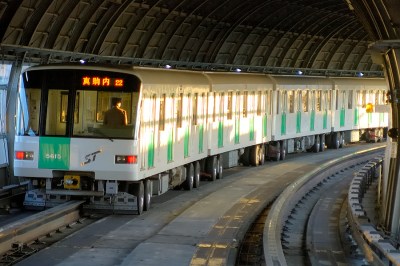
The system was not just limited to France, either. Mexico City found a rubber-tired metro to be the perfect transport solution, as the reduced vibrations were a massive boon given the area’s unstable soils. Other famous examples include the Montreal Metro in Canada, and lines 1, 2, and 5 of the Santiago Metro in Chile. Many other smaller-scale examples can be found around the world, often serving airport routes or shorter-distance lines.
Rubber-tired metros are unlikely to ever fully overtake more traditional steel-wheeled trains in popularity. There are more drawbacks than positives for most typical operations, particularly when it comes to maintenance and ongoing costs. Nevertheless, they have their place, particularly where grip is at a premium, grades are steep, or there is a keen desire to avoid excessive noise and vibration to keep the peace or avoid disturbing the subsurface. These rail-like curios stand out as a weird surprise treat for any railfan visiting Paris, or any of the other similar systems that can be found around the world.